
So. You’ve hit send on that first batch of queries. What now?
Well, hopefully, some full and partial manuscript requests. That’s the goal at the end of it all. But, unfortunately, you’re going to get some rejections. It’s part of the game! Personally, across both manuscripts I queried, I received a total of 160 query rejections. And even more than that when you count full/partial manuscript rejections.
Drinking game: Take a shot every time I use the word ‘rejection’ in this blog post. Just kidding, you’d die. Please drink responsibly so I can’t be held liable.
If you’re determined to continue down the route to traditional publishing, rejection is just one of those things you’re going to have to get used to. In my experience, it gets easier, but never easy. I queried for 11 months. I received multiple rejections every week. It sucks. Before I entered the trenches, I really didn’t know what to expect in terms of responses. My aim here is to prepare future query-ers for what to expect when you’re expecting rejections.
So, today I will be discussing the different types of rejections you’ll receive while querying, how to discern which type of rejection you’re getting, and how to deal with the not-so-nice rejections. Because not all agents are nice. That is something you’ll learn the hard way.
In this post I will be including a handful of screenshots from my own collection of query rejections as examples (with agent names cropped out of course) for what to expect in your query responses! Without further ado, let’s get into it.
FORM REJECTIONS
A ‘form rejection’ is a template used by agents sent to most/all authors whose queries they are rejecting. It is often a standard, basic rejection with no specific reference to the information provided in the query package (although it might seem like it). Not all agents will send form rejections, but about 85% do in my experience.
Form rejections tricked me once or twice, I won’t lie! They’re often a bit sneaky, worded in a way that makes you think the agent wrote them to you personally. In my humble opinion, I think this can be problematic, as it can lead an author to revise their opening pages based on what they believe is an agent’s personalized advice.
Here’s a few examples of form rejections I received that contain ambiguous wording that could potentially be misconstrued as personalized:

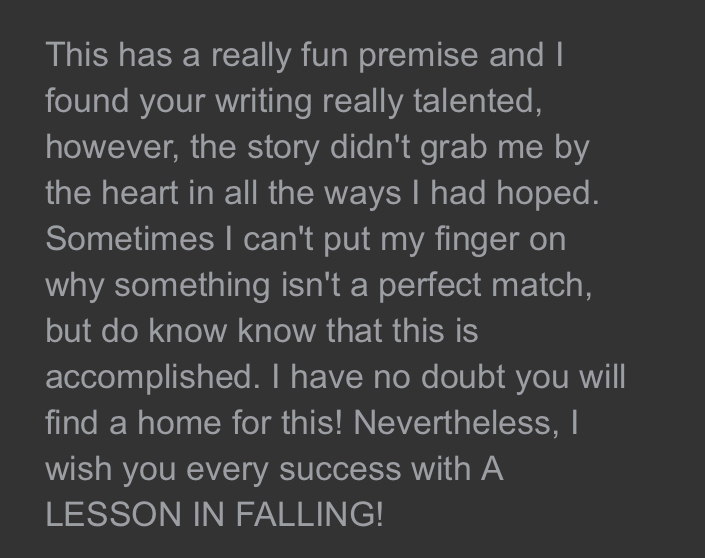
Notice the phrases, “The concept and voice of the sample pages didn’t connect with me as much as I’d hoped” and “This has a really fun premise and I found your writing talented, however, the story didn’t grab me by the heart in all the ways I had hoped.“
They sound personal, right? But, notice the lack of detail. No character names, no specific scene, no mention of tropes or what they actually enjoyed about the premise. If you read something like that in a query rejection, chances are it is a form template. If you can’t quite seem to figure it out, the comments on an agent’s QueryTracker page can be very helpful! Often times authors will share the rejections they received word for word so that others can discern whether or not the rejection is a form rejection, or personalization!
Now, here is an example of a form rejection that is straight to the point, and completely unambiguous:
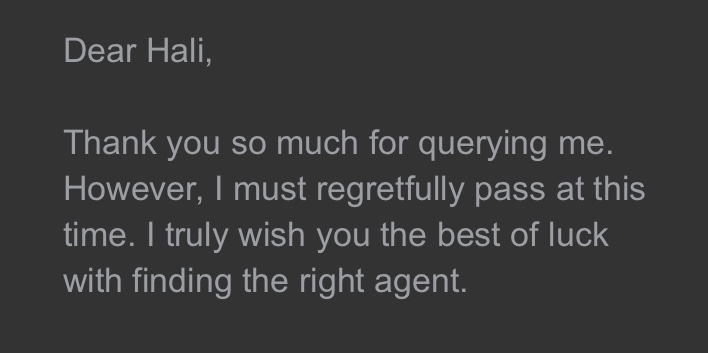
This was the type of query rejection I preferred the most out of all of them. In my opinion, many personalized rejections on a query alone can be more harmful than helpful. Let’s touch on that.
PERSONALIZED REJECTIONS
It is of my belief that a lot of personalized rejections from agents are unnecessary and unhelpful. Because, really, how much can an agent truly judge the strength of a manuscript when they’ve only read five pages and a synopsis? Most personalized feedback I received from agents aligned identically to advice provided from beta readers, so I didn’t exactly need that personalized feedback at all. And I suspect that might be the case for other authors as well.
I know most authors are dying to get personalized rejections, and hate form rejections with a passion, but personalizations are just entirely unnecessary and a waste of everyone’s time. The only time a rejection should be personalized is if they include the following:
- suggestions for the format of the query letter itself
- if they’re informing an author of the word count standards of the genre (i.e. if someone queried a 150k Adult Romance, when the standard is 80-100k)
- if they’re listing things they enjoyed about the query without providing suggestions of what to change
This is completely subjective, and a lot of people are going to disagree. That’s okay! Some authors find personalized agent feedback a vital tool. But I hate the idea of someone revising their manuscript based on a single agent’s response. What might be trash to one agent, could be treasure to another.
Here are some examples of personalized rejections I received. Let’s start with the good:

You can tell this is personalized because they mentioned the length of the manuscript specifically (the manuscript I queried was 98k words which, admittedly, is quite long for an Adult Romance). But this personalization is short, succinct, and kind without making suggestions for changes that might hurt the manuscript.
Now, let’s take a look at the bad:

While the middle and end of that rejection contain good suggestions, I want to focus a bit on the beginning.
“I’m trying to only take on projects that I feel are completely ready to go on submission.“

An agent is meant to help you through multiple stages of revision (if they feel your manuscript needs it) before sending it on submission to editors. That is, quite literally, their job. So, for an agent to actively inform you that they currently don’t want to help you or anyone else make your manuscript the best it can be…that’s a red flag, baby!
Here’s another:
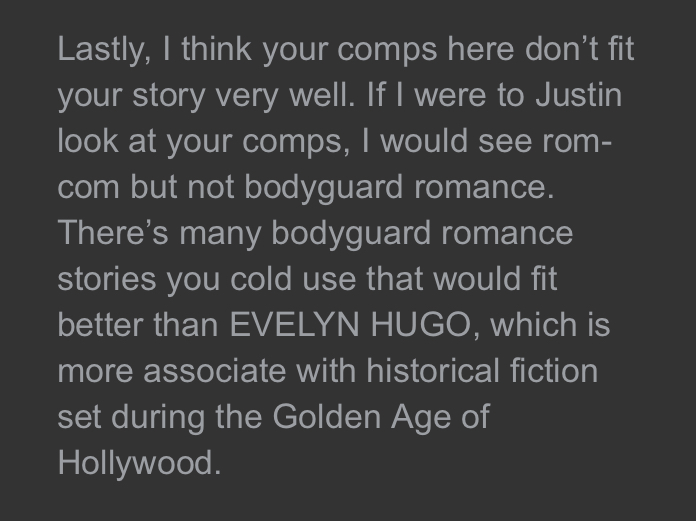
This is a snippet of a rejection that was so long that it took 8 screenshots just to send all of it to my friends to show them how ridiculous it was. I touch on this rejection in my The Do’s And Don’ts Of A Query Letter blog post, but I wanted to mention it here as a personalized rejection that had the potential to harm my manuscript rather than help it.
The aspect of THE SEVEN HUSBANDS OF EVELYN HUGO that I comped to in my query letter was the all-encompassing sapphic romance between world-famous celebrities, and this was the only time I received a rejection critiquing the use of it. Further, it was suggested that I comp a bodyguard romance instead, but…I did. TWISTED GAMES, the second book in the Twisted series by Ana Huang (an Adult Contemporary Romance between a princess and her bodyguard) was my other comp title.
“If I were to [just] look at your comps, I would see rom-com but not bodyguard romance.”
Neither of my comp titles were rom-coms……..???????????
Suffice to say, don’t take everything in a personalized rejection to heart.
FULL/PARTIAL REJECTIONS
These are the rejections that are going to hurt the most, I’m warning you now. When I received my first full manuscript rejection about 6 weeks after I started querying, I cried in bed for an hour straight. Of course, as you receive more full/partial rejections, it’ll hurt less because you’ll expect it and your hopes will have withered just a bit (grim, I know). But I wanted to give you an idea of what a full manuscript rejection will look like so that you’re completely prepared!
Unfortunately, a lot of your full manuscript rejections are still going to be form rejections. This is when I think a rejection should be personalized, even just a little, because once an agent requests more pages, it’s no longer a cold query in a slush pile. Receiving nothing but a “Sorry, this just isn’t a fit for my list,” on a full manuscript, makes it feel like they didn’t read it at all, which is just a totally shitty feeling.

Here are a few examples of full/partial manuscript rejections I received. Some are personalized, and some are form rejections similar to what you’d see on at the query rejection stage.
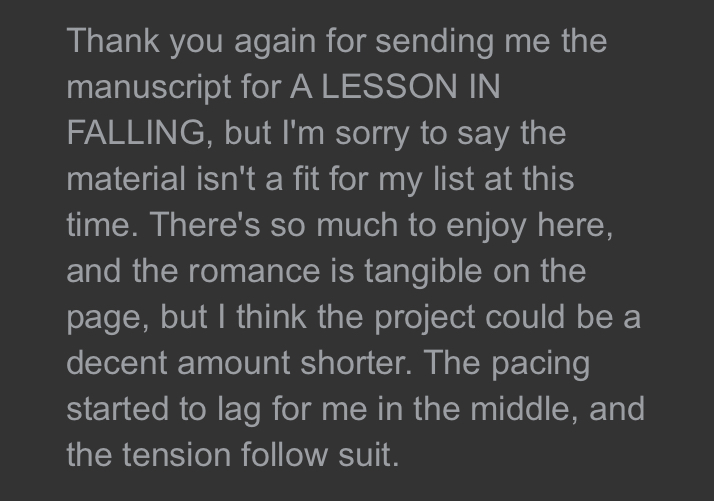
This rejection makes it clear that that agent read at least most of my manuscript, if not all of it. Even if they were rejecting it, it felt good to know they’d at least read it and really considered it rather than just tossing it out while attempting to clear their inbox.
This rejection, however…
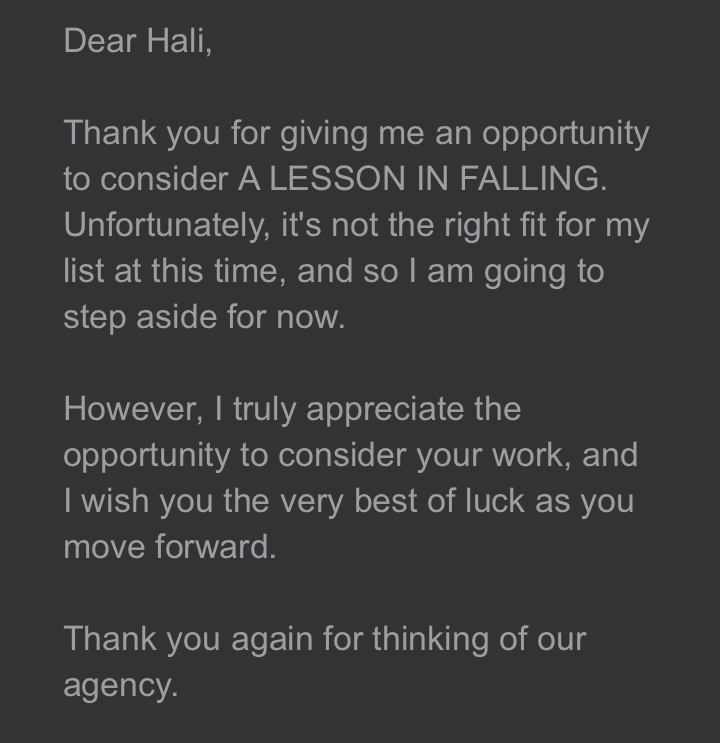
Almost indiscernible from a query rejection. But no, this is in fact a full manuscript rejection I received about a month and a half after the agent originally requested to see it.
So, this is what you have to look forward to. I’d estimate that maybe 50-60% of my full/partial rejections were form rejections, and that the rest were slightly personalized.
PITCH EVENT REJECTIONS
This type of rejections…..also suck.
What? I’m not going to lie to you!
When you participate in a pitch event on Twitter and in real life (learn more about pitch events here) an agent can request to see the manuscript if they’re interested. In my experience, all of my pitch event interest was garnered through likes on Twitter during #LGBTNPit, #MoodPitch, #SmoochPit, #DVPit, and #IWSGPit. I actually met my agent through both #MoodPit and #DVPit, so please don’t be frightened by what I’m about to tell you. Pitch events are truly an invaluable resource and networking opportunity for querying writers, and I’m unbelievably grateful for the privilege to participate.
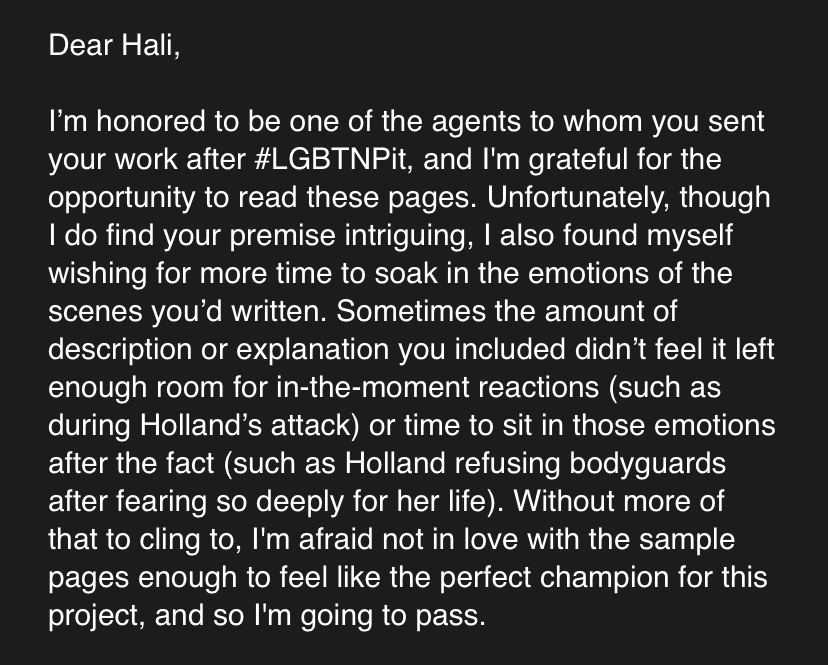
But, unfortunately, not all responses you’ll receive from pitch event likes will be positive. I’d estimate about 2/3 of my pitch event likes ended in some form of rejection. Because when an agent likes an idea, that doesn’t always necessarily mean they’ll connect with your writing. I’d say that a query sent after a pitch event request holds more hope than a regular cold query, and that’s why this rejection stings more than others.
Here is a rejection I received from an agent after they liked my Tweet during #LGBTNPit:
Sad face.
Don’t consider this a bad thing, though! An agent requesting to see pages because they’re intrigued by your idea is great! That means you’re on the right track. Keep cold querying and participating in pitch events!!
REVISE & RESUBMIT
ALL HOPE IS NOT LOST! If you receive even one revise and resubmit rejection, you’re doing something right!
A ‘revise and resubmit’ (or R&R) is when an agent rejects a query or a full manuscript in its current state, but provides details as to what they believe should be changed, then informs you that they’d be willing to reconsider after those revisions are made if you choose to do so!
I received one notable revise and resubmit rejection (sometimes agents are only vague, saying that they’d love to take another look after a big revision without stating what they’d like you to do). Here is what my R&R rejection looked like:
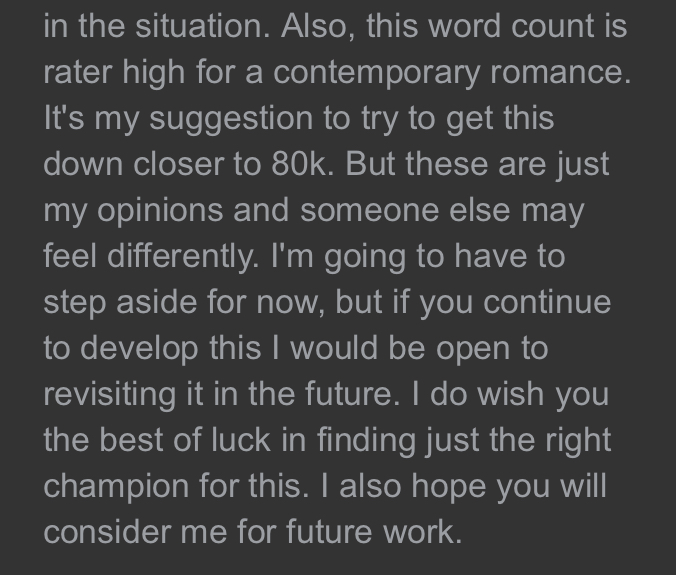
You can choose to move forward with an R&R however you wish. For me, this word count just wasn’t plausible with the story I was telling, and the agent mentioned some other changes to my opening pages that I didn’t agree with. So, I kept querying rather than pausing and working on an R&R.
Some agents might ask to hop on a call to discuss the R&R with you, which is a sign that they’re pretty serious about it. But be wary! Completing an R&R doesn’t always mean an agent will offer you representation. They might also reject your revised manuscript. Use your own judgment to decide whether or not the potential for representation is worth the amount of work you’ll be putting into the revision.
Let your brain make this decision, friends, not your heart.

MEAN REJECTIONS … YIKES!
These are the rarest type of rejection, and if you’re lucky, you’ll never get one.
I was not lucky.
Before I show you my two worst query rejections, I want you to remember that what a single agent says about your manuscript does not and will never matter in the grand scheme of things. It feels larger than it really is, but you have to remember that if they’re sending a rude ass rejection, they don’t really give a shit, and will forget about it in five minutes. So, that’s also what you need to do, too. That is, of course, after you send it to all your friends and groupchats and scream about how insane it is.
Now, here’s what you came for. I’ve mentioned this rejection a million times before, but here it is in all its glory, baby.

I tweeted about this rejection, and the agent actually ended up DMing me to apologize (not really an apology, more of an ‘I’m sorry you felt that way’ type of statement) but I didn’t give a fuck. I told her she shouldn’t have said that because agents might forget a rejection like this an hour after they send it, but its something an author will remember forever. She didn’t respond, but it’s the thought that counts.
Here is another rejection I received, this one only a month before I got my first offer of representation:

This was so crazy to read. THIS WAS A REPLY TO 10 PAGES AND A SYNOPSIS!!! NOT EVEN THE FULL MANUSCRIPT!!! This was also a part of the aforementioned 8-screenshot rejection with horrible advice, and as you can tell, it got even sillier. For context, this agent was sarcastically suggesting I replace the love interest’s sister who is in imminent danger with a cat or a dog instead…what the hell.

Now, I can look back on these rejections and laugh. But when I hadn’t yet secured representation, it just felt like an extra punch to the face that convinced me I may never find representation. The point of my showing you these rejections is so that you’ll know exactly what to expect, and know that you don’t deserve it.
Agents are meant to be professionals, and most of them are! But, if you happen to catch them on a bad day, it could result in rejections like these. It might feel world-ending at the time, but chances are, these crushing opinions are exclusive to just that agent. Getting rude feedback doesn’t mean that another agent won’t love your manuscript. Take it from me! The manuscript that incited both of these rejections is the one that got me my wonderful agent!
NO…REJECTION…?
One of the worst types of rejection is no rejection. By this, I mean when an agent ghosts your query (or even your full/partial manuscript) and never replies.
In an industry defined by the will-they-won’t-they of it all, it’s so frustrating to never receive an answer, even if it’s a rejection. Because, really, all anyone is looking for is one thing.
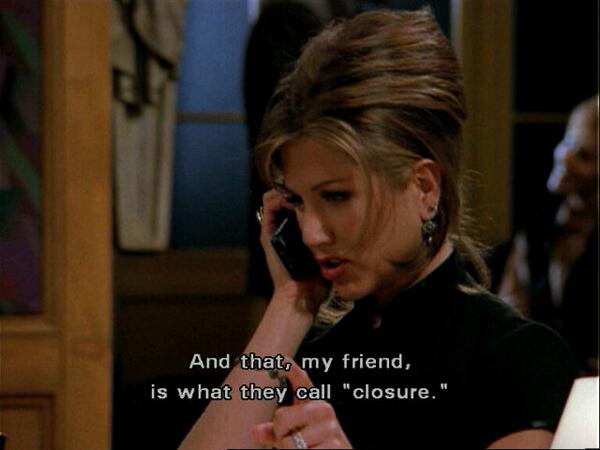
Sometimes an agency’s website will mention that they can’t respond to each individual query, and that no response after an allotted amount of time is a no, which is completely fine. You are free to confidently close out your query after that specific amount of time, and sleep well that night knowing that you’ve gotten closure.
This isn’t always the case. For example, an agent favorited my pitch Tweet in #LGBTNPit on Twitter in 2022. I sent her my query and she requested 5 chapters that same day. But, when I went to nudge her after receiving an offer, she never answered. After three weeks and three nudges, I was forced to close the query out without an answer, which really fucking sucked.
I’m here to warn you that a large portion of your queries are going to be ghosted. Or ‘ghosted’ in the sense that you think they’re never going to answer so you close out the query on your spreadsheets, then open your inbox a year and a half later on a random Tuesday to a form rejection from that weird agent you forgot you queried forever go.
In fact, I actually got one of those last week.

CONCLUSION
In hindsight, wading through all of my rejections at once to find suitable examples might not have been my best idea. I think I need to go lay down now like a Regency Miss who just had a particularly exhausting time at tea with the overcritical Dowager Duchess.
Sorry, I’ve been reading too much historical romance as of late.
I hope that this blog post helped future querying authors brace themselves for what to expect when they dive into the trenches. I also hope that everyone had a hearty laugh at my failures. It’s a silly business, querying.
If you enjoyed this post, please consider following me on Twitter, Instagram, and TikTok!! Also, if you’re feeling up to it, please enter your email below to subscribe to updates for when I publish a new blog post! I’m about to go on sub with my bodyguard romance, A LESSON IN FALLING, and I’ll make sure to provide updates regarding that journey here!
 Hali Hyland - Adult Romance Author